

By: Editorial Research Team
Evidence reviewed from peer-reviewed sources (see References)
Massage guns (percussive therapy devices) are everywhere—from gyms to home recovery routines. But what does research actually show? This article summarizes a published systematic review examining whether massage gun use may improve strength, explosive performance, flexibility, and musculoskeletal pain, and what limits the conclusions.
In this article
Massage Guns vs Vibration: Why the Difference Matters
Research on “vibration” is broad and includes whole-body platforms and localized vibration tools, with evidence suggesting short-term effects on flexibility and some performance outcomes in certain settings. [3]
Massage guns, however, deliver percussive therapy—rapid pulses that can differ in frequency, amplitude, and direction of force, meaning findings from generic vibration devices may not transfer 1:1. This is why massage-gun-specific evidence syntheses are particularly useful. [1]
How Was the Systematic Review Conducted?
A systematic review is designed to identify and evaluate all eligible research on a topic using a predefined method, helping reduce selective reporting compared with relying on one or two studies. [1]
In the review summarized here, researchers screened the literature and included 13 studies totaling 255 participants. [1]
Inclusion highlights (as reported by the review):
- Adults aged 18+ [1]
- Percussive therapy delivered via massage gun applied to a target muscle [1]
- Outcomes included strength, explosive strength, flexibility/ROM, or musculoskeletal pain experiences [1]
- Compared against control/placebo/other interventions depending on the study [1]
Transparency note: The review was registered on PROSPERO (CRD42021253767). [4]
Quality caution (important): The authors report that all included studies had methodological or reporting limitations, which reduces confidence in exact effect sizes and prevents firm “best protocol” recommendations. [1]
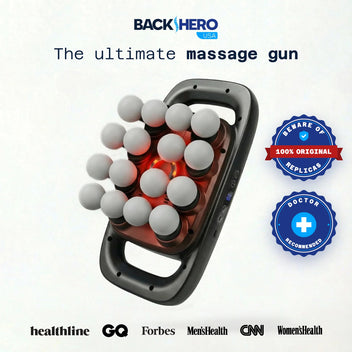
When your back, shoulders, and legs feel tight after a long day, this is your go-to reset. The Back Hero US...
What the Review Found: Strength, Power, Flexibility, and Pain
1) Massage Guns and Strength
The review suggests percussive therapy delivered by massage guns can be associated with acute (short-term) improvements in muscle strength in some contexts. [1]
However, the evidence is not uniform because the included studies varied widely in:
- device settings (speed/frequency),
- attachments and pressure,
- treated muscles,
- and strength testing methods. [1]
Interpretation: Massage guns may help short-term readiness for some users, but they are not established as a stand-alone method for building long-term strength. [1]
2) Massage Guns and Explosive Performance (Power)
Explosive strength reflects how quickly you can generate force (important for sprinting, jumping, striking, and many sports). The review reports evidence suggesting massage gun use may improve some explosive strength outcomes acutely. [1]
But results can differ across the wider literature. A separate systematic review (2023) found massage guns may improve flexibility and some recovery outcomes, while performance effects can be mixed depending on protocol and tests used. [5]
Interpretation: Massage guns may enhance certain explosive measures in some scenarios, but they should not be assumed to improve athletic performance universally. [1], [5]
3) Massage Guns and Flexibility (Range of Motion)
Across the studies included, flexibility/ROM was the most consistent “signal”: the review reports immediate improvements after a single session. [1]
This is supported by experimental work showing ROM improvements after a short percussive treatment (e.g., Hypervolt on plantar flexors). [6]
Interpretation: If your main goal is feeling less stiff or improving ROM before activity, the evidence base is most consistently favorable here—primarily for short-term effects. [1], [6]
4) Massage Guns and Pain Experiences
The review suggests massage guns may reduce experiences of musculoskeletal pain, especially when used repeatedly over time rather than as a one-off session. [1]
This is meaningful because pain—particularly persistent pain—can affect daily function, mental well-being, and quality of life. [7]
Interpretation: Massage guns may be useful as part of a broader pain-management routine for some people, but stronger trials are still needed to confirm best protocols and long-term outcomes. [1], [7]
Why We Still Don’t Have a “Best” Massage Gun Protocol
A major limitation highlighted by the review is protocol variability:
- duration (seconds to minutes),
- device settings and attachments,
- treated body regions,
- and measurement methods. [1]
Because of this, the review can more confidently discuss whether massage guns can help in certain outcomes than provide a universal “do X minutes at Y speed” prescription. [1]
What This Means for Athletes and Everyday Users (Practical, Not Overstated)
For mobility and warm-ups
If you want a fast mobility boost, the evidence most consistently suggests short-term ROM improvements after a session. [1], [6]
For performance
Some short-term improvements in strength or explosive outcomes are reported, but results depend on protocol and context. Treat a massage gun as a readiness tool—not a guarantee. [1],[5]
For pain
Repeated use may be more relevant than one session, but persistent pain should be clinically evaluated and managed with an individualized plan. [1], [7]
Key Takeaways
- Massage guns may improve short-term flexibility/ROM most consistently. [1]
- Evidence suggests possible acute improvements in strength and explosive outcomes, but results vary by protocol and population. [1],[5]
- Pain experiences may improve more with repeated use, but study quality limits certainty and “best protocol” guidance is not settled. [1]
- More standardized, higher-quality research is needed to define optimal treatment plans. [1], [4]
Reference
Dueñas, M., Ojeda, B., Salazar, A., Micó, J. A., & Failde, I. (2016). A review of chronic pain impact on patients, their social environment and the health care system. Journal of Pain Research, 9, 457–467. https://doi.org/10.2147/JPR.S105892
Ferreira, R. M., Silva, R., Vigário, P., Martins, P. N., Casanova, F., Fernandes, R. J., & Sampaio, A. R. (2023). The effects of massage guns on performance and recovery: A systematic review. Journal of Functional Morphology and Kinesiology, 8(3), Article 138. https://doi.org/10.3390/jfmk8030138
Konrad, A., Glashüttner, C., Reiner, M. M., Bernsteiner, D., & Tilp, M. (2020). The acute effects of a percussive massage treatment with a Hypervolt device on plantar flexor muscles’ range of motion and performance. Journal of Sports Science & Medicine, 19(4), 690–694. https://pmc.ncbi.nlm.nih.gov/articles/PMC7675623/
Mackay, L., Langdown, B., Simons, J., & Vseteckova, J. (2021). The effect of percussive therapy on musculoskeletal performance and perceptions of pain: A systematic narrative literature review (PROSPERO Registration No. CRD42021253767). PROSPERO. https://www.crd.york.ac.uk/prospero/display_record.php?ID=CRD42021253767
Rasti, E., Rojhani-Shirazi, Z., Ebrahimi, N., & Sobhan, M. R. (2020). Effects of whole body vibration with exercise therapy versus exercise therapy alone on flexibility, vertical jump height, agility and pain in athletes with patellofemoral pain: A randomized clinical trial. BMC Musculoskeletal Disorders, 21, Article 705. https://doi.org/10.1186/s12891-020-03732-1
Sams, L., Langdown, B. L., Simons, J., & Vseteckova, J. (2023). The effect of percussive therapy on musculoskeletal performance and experiences of pain: A systematic literature review. International Journal of Sports Physical Therapy, 18(2), 309–327. https://doi.org/10.26603/001C.73795
Sams, L., Langdown, B., Simons, J., & Vseteckova, J. (2024, July 23). Massage guns can improve strength and flexibility and reduce experiences of pain, according to systematic review. Therabody. https://www.therabody.com/blogs/news/massage-guns-can-improve-strength-and-flexibility-and-reduce-experiences-of-pain-according-to-systematic-review

